
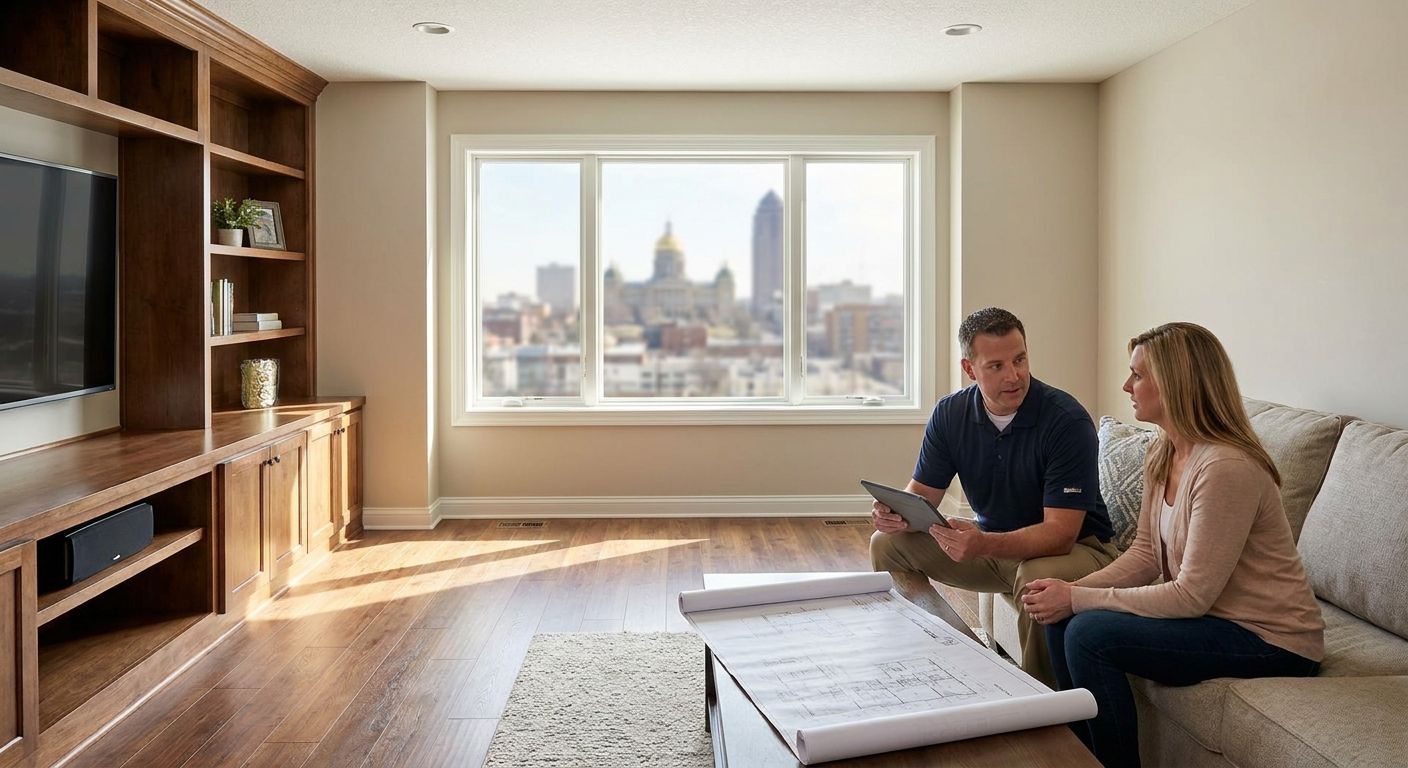
Basement finishing costs in Des Moines depend on square footage, finish level, and what's hiding behind your foundation walls — this guide breaks down what drives the number and how to get an accurate estimate before you sign anything.
- Basement finishing in Des Moines typically runs $20,000-$70,000 in 2026 depending on size and finish level.
- Egress windows, moisture control, and permit fees are the costs most homeowners forget to budget for.
- Ceiling height and foundation condition can disqualify a basement from full code-compliant finishing before you spend a dollar.
- Phoenix Construction Solutions handles basement finishing and additions across Central Iowa — get a written walkthrough quote before comparing per-square-foot numbers.
Why this matters
A basement finishing quote that looks cheap on paper often excludes egress windows, HVAC extension, or moisture remediation — three items that can add $8,000-$15,000 to a project after the contract is signed. Des Moines basements sit on clay-heavy Iowa soil, which means moisture and foundation movement show up more often here than in newer-build markets. Pricing the job right the first time means walking the space before you set a budget, not after a contractor already has a deposit.
Central Iowa cities including Ankeny, Urbandale, Waukee, and West Des Moines share similar soil and code conditions, so the cost drivers below apply whether your basement sits in a 1970s Des Moines rambler or a newer build in Waukee.
What you'll need
- A tape measure and rough sketch of your basement footprint
- A moisture reading or professional inspection — a $150-$300 line item that can save thousands
- Written quotes from at least three licensed, insured contractors
- Local permit requirements from your city's building department (egress, electrical, plumbing)
- A contingency fund equal to 10-20% of your estimated budget
- Photos of your foundation walls, sump pump, and any visible cracks or staining
The steps: how to budget an accurate basement finishing cost
1. Measure and assess the space
Start with total square footage and ceiling height, since both directly set your per-square-foot cost. Most Iowa building codes require a minimum ceiling height — often 7 feet — for a space to count as finished living area. A basement that measures under that threshold in spots can still be finished, but it limits which areas qualify as bedrooms or bathrooms.
Common mistake: measuring wall-to-wall instead of usable floor space after mechanicals, support posts, and stairwells are accounted for. That gap between raw and usable square footage is where budgets go wrong first.
2. Check for moisture and foundation issues before anything else
A basement with active water intrusion needs remediation before drywall, insulation, or flooring goes in — skipping this step is the single most expensive mistake homeowners make. Look for efflorescence (white mineral staining), musty odor, or a sump pump that runs constantly during rain. Any of these signals foundation or drainage work that has to happen first, not simultaneously.
Common mistake: painting over visible cracks or staining to make the space presentable for a contractor walkthrough, which hides the real scope and leads to change orders mid-project.
3. Decide your finish level
Basic finishing (drywall, paint, carpet, standard lighting) costs less per square foot than a custom build with a wet bar, full bathroom, or home theater wiring. Decide this before requesting quotes, because "finish a basement" means something different to every contractor unless you specify the scope.
Common mistake: asking for a "ballpark number" without specifying finish level, which produces quotes that aren't comparable to each other.
4. Account for permits and code requirements
Egress windows are the biggest code-driven cost in most Des Moines basement projects — required for any room used as a bedroom, and often recommended even when not strictly required. Permit fees, inspections, and electrical code updates (GFCI outlets, smoke detectors) add cost that's easy to miss in a verbal estimate.
Common mistake: assuming an unpermitted basement finish saves money — unpermitted work is a documented liability at resale and can force a homeowner to redo work before closing.
5. Budget for mechanicals
Extending HVAC ductwork, adding electrical circuits, and rough-in plumbing for a bathroom or wet bar are line items that get buried in a lump-sum quote. Ask each contractor to itemize mechanicals separately so you can see where the money actually goes.
Common mistake: assuming existing HVAC capacity is sufficient for the added square footage — an undersized furnace struggles to heat a finished basement through an Iowa winter.
6. Get itemized quotes from licensed local contractors
Three written quotes from licensed, insured contractors is the minimum for comparing basement finishing cost accurately. Ask each one to break out labor, materials, permits, and mechanicals as separate line items rather than one total number.
Common mistake: choosing the lowest bid without confirming it includes the same scope as the others — a $10,000 gap between quotes usually means one contractor excluded something the other included.
7. Build in a contingency buffer
Set aside 10-20% of your total budget for surprises — this is standard practice for any basement project because what's behind a finished wall or under old flooring isn't fully known until demo starts. Foundation issues, outdated wiring, or asbestos in older insulation are common finds in Des Moines-area homes built before 1990.
Common mistake: spending the full budget on finishes before confirming the structural and mechanical work is complete, leaving nothing for the inevitable surprise.
Get a basement finishing quote
Licensed and insured, serving Des Moines and Central Iowa.
Troubleshooting: common basement finishing cost problems
Problem: your quote came in far higher than expected. Ask for an itemized breakdown by category — labor, materials, permits, mechanicals. A vague lump sum almost always hides scope you didn't ask for or excludes something you assumed was included.
Problem: your basement ceiling is too low for code-compliant finishing in some areas. Some basements need floor lowering or duct rerouting to hit minimum ceiling height in key rooms. This adds cost but is often cheaper than living with a non-compliant space you can't legally call a bedroom.
Problem: the sump pump can't keep up during heavy rain. An undersized or aging sump pump is a foundation-level problem, not a cosmetic one. Replace or upgrade it before finishing walls and flooring — moisture behind new drywall is expensive to fix twice.
Problem: your budget didn't account for egress windows. Egress window wells require excavation and structural work on top of the window itself. Get this priced separately and early, since it's one of the larger single line items in most Des Moines basement projects.
Problem: permit delays are pushing back your timeline. Cities across Central Iowa — Des Moines, Ankeny, Urbandale, Waukee — each run their own permit review timeline. Ask your contractor upfront how long their typical permit turnaround runs before you set a completion date.
Problem: you're comparing quotes that don't match in scope. Go back to each contractor and confirm finish level, mechanicals, and permit inclusion are identical across every quote. A $15,000 gap between two bids on the same basement usually traces back to a scope mismatch, not a pricing difference.
Tools and resources
- A written scope of work from every contractor you get a quote from
- Your city's building permit office contact information
- A moisture meter or a professional inspection before demo starts
- How to plan a home addition in Central Iowa — useful if your basement project is part of a larger addition or renovation plan
- Phoenix Construction Solutions, licensed and insured, for a walkthrough quote on basement finishing across Central Iowa
What to do next
Once you've measured the space, checked for moisture, and decided on a finish level, the next move is a walkthrough with a licensed contractor who can confirm ceiling height, sump pump condition, and egress requirements in person. If your basement project is tied to a larger home addition or renovation, review how to plan a home addition in Central Iowa before finalizing your budget — the two projects often share permits and mechanical work.
FAQ
How much does basement finishing cost in Des Moines?
Basement finishing in Des Moines typically runs $20,000-$70,000 in 2026 depending on square footage and finish level. Custom builds with a bathroom, wet bar, or home theater push toward the higher end of that range.
Do I need a permit to finish my basement in Iowa?
Yes, finishing a basement generally requires a building permit in Central Iowa cities including Des Moines, Ankeny, and Waukee. Skipping the permit creates liability at resale and can force costly rework later.
What adds the most cost to a basement finishing project?
Egress windows, moisture remediation, and HVAC extension are the three biggest cost drivers beyond basic drywall and flooring. Each can add several thousand dollars depending on the scope of work required.
Is basement finishing cheaper than a home addition?
Basement finishing is usually cheaper per square foot than a home addition since the foundation and framing already exist. An addition adds new structure, roofing, and exterior finishes that a basement project skips entirely.
How long does it take to finish a basement in Des Moines?
A standard basement finishing project runs 6-12 weeks depending on scope, permit timelines, and whether moisture or foundation issues surface during demo. Custom builds with plumbing rough-in take longer than basic drywall-and-flooring jobs.
Can I finish a basement with a low ceiling height?
You can finish a low basement, but rooms used as bedrooms typically need to meet a minimum ceiling height under Iowa building code, often around 7 feet. Some homeowners lower the floor or reroute ductwork to hit compliance in key areas.
Should I get multiple quotes before finishing my basement?
Yes, three itemized quotes from licensed, insured contractors is the standard for comparing basement finishing cost accurately. Confirm each quote covers the same scope before comparing the bottom-line number.
What's the difference between basic and custom basement finishing?
Basic finishing covers drywall, paint, standard flooring, and lighting, while custom finishing adds features like a full bathroom, wet bar, or home theater wiring. Custom work costs more per square foot and takes longer to complete.
One last thing
The sump pump is the cheapest insurance policy in a basement finishing project — a $300-$500 upgrade before you drywall is far less expensive than tearing out finished walls after a spring flood. Check it before you check anything else on your renovation checklist.